Connect with us

Technology

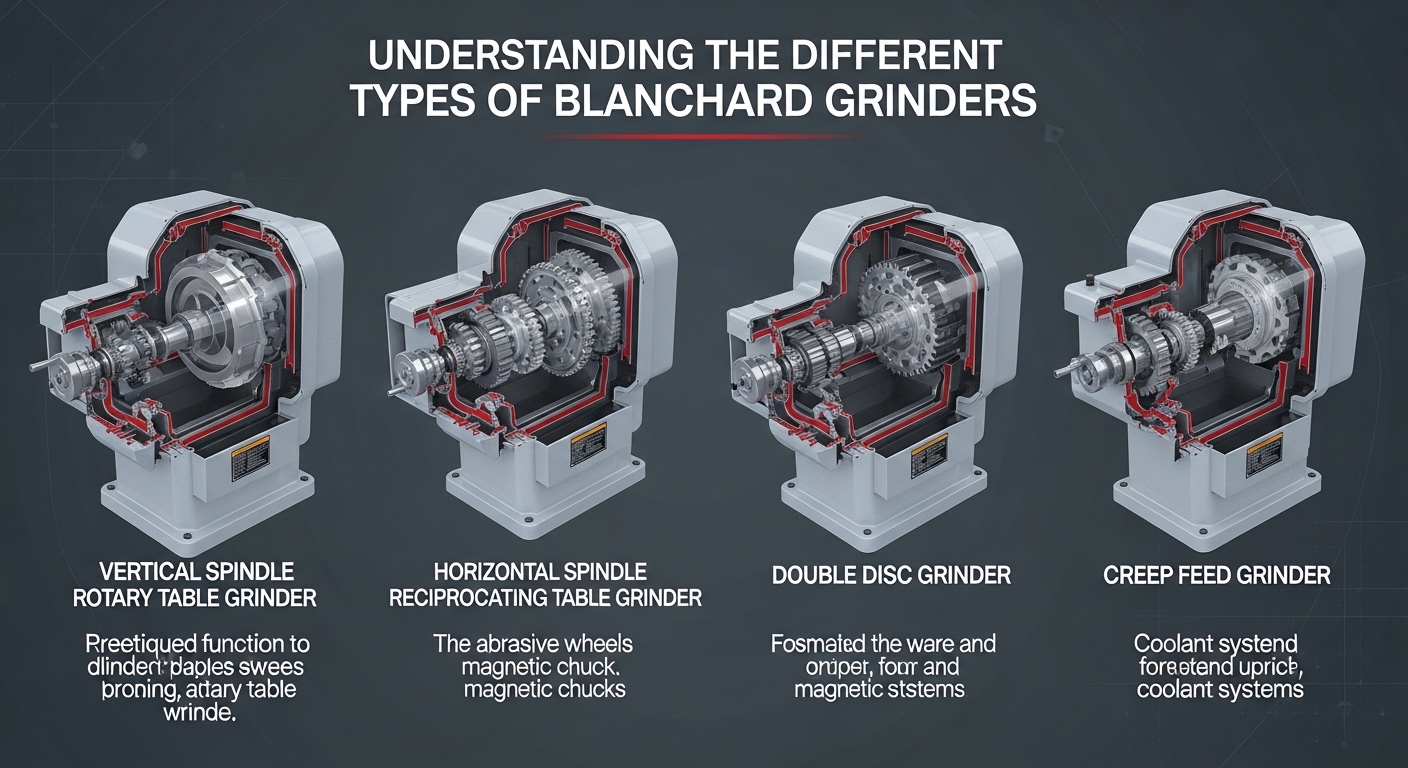
Understanding the Different Types of Blanchard Grinders

Published

on

Blanchard grinders use a rotating abrasive wheel to grind metal pieces to a specific thickness. The grinding wheel and magnetic chuck manage large volumes and sizes for consistent grinding, whether for single pieces or multiple batch parts. Grinders often vary by size, capacity, and automation level, and knowing your project goals helps you select the right model. Some different types of grinders include:

Small Chuck Grinders

On a Blanchard grinder, the chuck is the machine’s table where the workpiece is placed. It is often magnetic, so it secures and stabilizes the workpiece beneath the grinding wheel during use. Grinders with small chucks typically have a diameter of 16 to 20 inches, which guides the size of the workpiece the machine can process. Smaller grinders require less floor space in workshops, while still providing accurate detail work and variable speed controls. Because the grinder is smaller, the spindle motor speed and amperage are lower than in larger units. This makes them more suitable for small batch parts, such as stampings or weldments. They may be beneficial for removing surface material from foundry-cast or forged parts. Small grinders are also good for prototype work, and they enable efficient short production runs.

Medium Chuck Grinders

Medium-sized Blanchard grinders are used for medium-volume production of larger workpieces. These units have more power, higher speeds, and larger table and spindle sizes than the small models. Some medium grinders are equipped with lubrication and coolant delivery systems to maintain accuracy and surface finish. They are suitable for shops that need both production efficiency and precision for moderately sized parts.

Medium grinders have 36- to 40-inch diameters, enabling them to process large circular parts, such as flywheels, turbine rings, or bearings. These machines can also grind multiple smaller pieces simultaneously. Medium grinders typically have higher spindle capacity; this provides greater stability for heavy workpieces and helps improve surface finish. Some grinders also have adjustable speed settings, so you can enhance performance from piece to piece. 

Large Chuck Grinders

Grinders with larger chucks are designed to manage large jobs with substantial material removal requirements. Grinders with 48- to 60-inch chucks are suitable for a range of production requirements, such as: 

  • Grinding large, flat surfaces to achieve a smooth finish
  • Achieving precise thickness and dimensional tolerances
  • Preparing surfaces for subsequent machining, coating, or assembly
  • Completing high-volume production runs while maintaining consistent quality

With their structural strength and capacity, they handle a range of materials, from ferromagnetic metals to various nonferrous alloys. Their design incorporates features that support precise control over a part’s final dimensions and surface properties. These grinders are frequently used in metal fabrication, aerospace, and energy industries for large-scale component finishing.

High-Volume Grinders

High-volume models have 60- to 100-inch chucks, enabling companies to achieve uniform material handling, reliability, and performance. These advantages are supported by technological improvements in design and control systems. The larger chucks and higher horsepower support the demands of industrial-scale production; these are beneficial in sectors like heavy machinery, automotive parts, and metal fabrication to deliver uniform results across production cycles without compromising reliability or efficiency.

These grinders can also process extremely large or heavy workpieces, such as turbine rotors, generator flywheels, and industrial rolls. Since they are often equipped with automated feed systems, the movement of the workpiece or chuck is controlled automatically. This verifies a consistent speed so that excess material is removed uniformly from the workpiece. Some settings, such as speed and direction, are adjustable, and this allows manufacturers to adjust their machinery for specific parts. 

High-volume grinders are typically designed for continuous operation; this makes them suitable for long production runs. They also maintain consistent performance over extended periods. Integrated coolant and lubrication systems help reduce the machinery’s temperature, which impacts how quickly the machine wears out. 

Explore Blanchard Grinders Today

Selecting the right Blanchard grinder involves reviewing your manufacturing applications and desired surface finish. The goal is to optimize performance while making sure the grinder’s features and capabilities align with your operations. Evaluating chuck size, motor power, cooling system, and capacity also supports informed grinder selection. Conducting scheduled maintenance may maximize your machine’s operational life and effectiveness. Work with a new and used machinery provider today to learn more about available Blanchard grinders.


Continue Reading

Technology

Emerging Trends in Mechanical CAD Design Services Every Engineer Should Know in 2026

Published

on

By

The mechanical engineering world is changing faster than ever. What once revolved around static drawings and isolated workflows has evolved into intelligent, cloud-connected, data-driven design ecosystems. As we move into 2026, mechanical CAD design services are no longer just about drafting components; they’re shaping how products are conceived, validated, manufactured, and even serviced.

For engineers, architects, startups, and decision-makers across the UK, USA, and global markets, staying ahead of these changes isn’t optional. It’s a competitive necessity.

So what exactly is changing? Which trends will define the future of mechanical design and drafting services? And how can engineering teams prepare for what’s next?

Let’s break it down.

Why Are Mechanical CAD Design Services Evolving So Rapidly?

Several forces are driving change across the CAD design and drafting industry:

  • Increasing product complexity
  • Shorter development cycles
  • Globalized engineering teams
  • Pressure to reduce costs without sacrificing quality
  • Growing demand for sustainability and compliance

According to a McKinsey engineering productivity study, companies that adopt advanced digital engineering tools can reduce development time by up to 30% while improving design quality. This is pushing businesses to rethink how they approach mechanical engineering service delivery.

How Is AI Transforming Mechanical CAD Design in 2026?

Artificial Intelligence is no longer experimental in CAD, it’s becoming foundational.

Modern mechanical CAD design services now leverage AI for:

  • Automated design suggestionsbased on performance criteria
  • Generative design, where software creates multiple optimized design options
  • Error detectionin assemblies and tolerances
  • Design rule validationearly in the process

A recent Autodesk industry outlook highlights that over 60% of manufacturing-focused engineering firms are already using some form of AI-assisted design, with adoption expected to rise sharply through 2026.

For engineers, this means less time fixing issues and more time solving real-world problems.

Are Mechanical 2D Drafting Services Still Relevant?

Yes, but their role is evolving.

While 3D modeling dominates conceptual and simulation workflows, mechanical 2D drafting services remain critical for:

  • Fabrication drawings
  • Compliance documentation
  • Legacy system compatibility
  • On-site manufacturing and installation teams

What’s changing is how 2D drafting is delivered:

  • Intelligent annotations linked to 3D models
  • Automated dimension updates from parametric designs
  • Better integration with ERP and manufacturing systems

In the UK and USA, industries such as HVAC, industrial equipment, and plant engineering still rely heavily on precise 2D documentation making skilled drafting services just as important as ever.

Why Is Cloud-Based CAD Becoming the New Standard?


Cloud adoption has exploded across engineering teams and CAD is no exception.

In 2026, leading mechanical design and drafting services increasingly operate on cloud-based platforms that enable:

  • Real-time collaboration across regions
  • Version control without manual file handling
  • Secure access for remote engineering teams
  • Faster design reviews and approvals

According to a Gartner cloud engineering report, over 70% of engineering organizations are expected to use cloud-based CAD and PLM tools by 2026.

For global teams working across the UK, USA, Europe, and Asia, this shift dramatically improves speed and coordination.

How Are Digital Twins Reshaping Mechanical Engineering Services?

Digital twins are becoming a game-changer in mechanical design.

A digital twin is a virtual replica of a physical product or system that evolves throughout its lifecycle. In advanced mechanical engineering service workflows, digital twins allow teams to:

  • Simulate real-world performance before manufacturing
  • Predict maintenance issues
  • Test design changes without physical prototypes
  • Optimize performance over time

A Siemens engineering digitalization study reports that digital twin adoption can reduce prototype costs by up to 40% and significantly improve product reliability.

In 2026, digital twins are no longer limited to large enterprises; they’re becoming accessible to mid-sized engineering firms and startups as well.

What Role Does Sustainability Play in CAD Design Today?

Sustainability is no longer a buzzword, it’s a design requirement.

Mechanical CAD design services are now expected to support:

  • Lightweighting through topology optimization
  • Material efficiency analysis
  • Lifecycle impact assessments
  • Compliance with environmental regulations

In the UK, stricter carbon reporting standards are influencing how mechanical systems are designed from day one. Engineers increasingly rely on CAD tools that can simulate energy consumption, material waste, and recyclability early in the design process.

This shift creates opportunities for CAD teams who understand both engineering performance and environmental responsibility.

How Is Automation Changing Mechanical Design and Drafting Services?

Automation is quietly transforming everyday CAD workflows.

In 2026, forward-thinking mechanical design and drafting services use automation for:

  • Standard part libraries
  • Automated BOM generation
  • Rule-based drawing creation
  • Template-driven documentation

This doesn’t replace engineers, it frees them.

By automating repetitive tasks, engineering teams can focus on innovation, system integration, and problem-solving rather than manual drafting work.

What Challenges Do Engineers Face with Modern CAD Services?

Despite the benefits, several challenges remain:

  • Skill gapsin advanced CAD and simulation tools
  • Integration issuesbetween CAD, CAE, and PLM systems
  • Data security concernsin cloud-based environments
  • Change managementwithin traditional engineering teams

A UK Engineering Skills Survey notes that over 45% of engineering firms struggle to find professionals skilled in modern CAD workflows making external service partners increasingly valuable.

Why Are Outsourced Mechanical CAD Design Services Growing?

Outsourcing is no longer just about cost savings.

Global demand for specialized mechanical CAD design services is growing because companies want:

  • Access to niche expertise
  • Flexible scaling for projects
  • Faster turnaround times
  • Reduced overhead costs

In the USA and UK, many firms now use a hybrid model keeping core engineering in-house while outsourcing drafting, detailing, and simulation to trusted CAD partners.

This approach allows businesses to stay agile without compromising quality.

What Opportunities Should Engineers and Businesses Watch in 2026?

Looking ahead, the biggest opportunities in mechanical CAD include:

  • AI-driven generative design expertise
  • Industry-specific drafting specializations
  • Digital twin modeling services
  • Sustainable engineering consulting
  • Cloud-native CAD collaboration workflows

Engineers who invest in these skills and businesses that align with capable CAD partners will be best positioned to compete globally.

Final Thoughts:

The future of mechanical CAD design services is intelligent, collaborative, and deeply integrated with the entire product lifecycle. From AI-powered modeling to cloud-based collaboration and sustainable engineering, 2026 marks a turning point for how mechanical design and drafting services are delivered.

For organizations across the UK, USA, and beyond, the key isn’t just adopting new tools, it’s working with teams that understand how to apply them strategically.

Many forward-looking businesses are already partnering with experienced UK-based CAD design companies that combine engineering expertise with modern digital workflows, helping them stay competitive in a rapidly evolving landscape.

The question is no longer if mechanical CAD will change but how ready you are to evolve with it.


FAQs

1. What are mechanical CAD design services, and why are they important in 2026?

Mechanical CAD design services involve creating detailed 2D drawings and 3D models used for designing mechanical components and systems. In 2026, these services are crucial because modern engineering demands faster design cycles, higher accuracy, AI-driven optimization, and seamless collaboration across global teams.

2. How is AI impacting mechanical CAD design services in 2026?

AI is transforming mechanical CAD design services by automating repetitive tasks, enabling generative design, detecting design errors early, and optimizing components for performance, cost, and material efficiency helping engineers deliver smarter designs in less time.

3. Are mechanical 2D drafting services still used alongside 3D CAD modeling?

Yes, mechanical 2D drafting services remain essential for manufacturing drawings, compliance documentation, and fabrication workflows. While 3D modeling drives visualization and simulation, 2D drawings are still widely required in industries across the UK and USA.

4. What role does cloud-based CAD play in modern mechanical design and drafting services?

Cloud-based CAD allows engineers to collaborate in real time, manage versions securely, and access designs from anywhere. In 2026, cloud platforms are becoming standard for mechanical design and drafting services, especially for global engineering teams.

5. How do digital twins improve mechanical engineering services?

Digital twins create virtual replicas of mechanical systems that simulate real-world behavior. They help engineers test designs, predict failures, reduce prototyping costs, and improve performance throughout the product lifecycle making them a key trend in mechanical engineering services.

6. Why is sustainability influencing mechanical CAD design trends?

Sustainability is shaping mechanical CAD design services by encouraging lightweight designs, material optimization, energy-efficient systems, and lifecycle analysis. UK and global regulations are pushing engineers to consider environmental impact during the early design stages.

7. Why are companies outsourcing mechanical design and drafting services globally?

Companies outsource mechanical design and drafting services to access specialized expertise, reduce project timelines, scale resources flexibly, and maintain cost efficiency. This trend is especially strong in the UK and USA, where engineering firms seek high-quality CAD support without increasing overhead.

Continue Reading

Technology

SydneeBeeYXO: The Influencer Redefining Authenticity in the Digital Age

Published

on

By

sydneebeeyxo

The first time I noticed the name sydneebeeyxo, it didn’t arrive with a press release or a polished website. It surfaced the way most modern brands do—organically, through conversation, content, and curiosity. A username turned into a signal. A signal turned into attention. And attention, when handled with intention, becomes influence. This is the quiet story of how digital identities are being built today, and why sydneebeeyxo represents something larger than a single online presence.

In a world where platforms change faster than business models, the most durable asset isn’t a product or even a company. It’s identity. Sydneebeeyxo sits at the intersection of personal branding, creator economics, and the evolving expectations of online audiences. For entrepreneurs, founders, and tech readers, understanding this evolution isn’t optional—it’s foundational.

The Rise of the Handle as a Brand

Not long ago, brand names were carefully engineered in boardrooms. Today, many begin as usernames. Sydneebeeyxo fits this pattern perfectly: a digital-first identity that feels personal, memorable, and adaptable across platforms. It’s not weighed down by legacy meaning, which is precisely its strength.

Handles like this thrive because they are platform-native. They feel at home on social media, community forums, and emerging creator tools. Instead of sounding like a corporation trying to be relatable, they start as relatable and grow into something more structured over time.

For founders watching this trend, the lesson is simple but powerful. Audiences now connect with names that feel human before they feel commercial. Sydneebeeyxo reflects a broader shift where trust is built through presence and consistency rather than scale alone.

Why Digital Identity Now Matters More Than Ever

The internet has entered a phase where visibility is no longer scarce, but credibility is. Anyone can publish, post, or stream. What separates lasting digital identities from forgettable noise is coherence. Sydneebeeyxo works because it suggests a single point of reference across multiple touchpoints.

From a strategic perspective, this matters deeply to entrepreneurs and tech leaders. Digital identity is becoming a form of soft infrastructure. It supports community building, monetization, partnerships, and long-term relevance. Without it, even well-funded ventures struggle to maintain attention.

What makes sydneebeeyxo especially interesting is how it aligns with this reality. It doesn’t feel forced into one category. It can evolve with platforms, trends, and audience expectations without losing recognition.

The Human Layer Behind the Screen

Every successful digital identity carries an implied story. Sydneebeeyxo suggests more than content; it hints at perspective. Audiences today are drawn to voices that feel lived-in, not manufactured. They want creators and brands that respond, adapt, and occasionally reveal uncertainty.

This is where many traditional marketing strategies fail. They prioritize polish over presence. Sydneebeeyxo, by contrast, benefits from the sense that there is a real person—or at least a consistent point of view—behind the name. That perception alone increases engagement, even before any explicit value proposition is introduced.

For tech founders, this has implications beyond social media. Product storytelling, founder visibility, and community leadership now all borrow from the same playbook. The brand is no longer separate from the voice that represents it.

sydneebeeyxo as a Signal in the Creator Economy

The creator economy has matured. It’s no longer just about viral moments or follower counts. Sustainable creators build ecosystems, not just audiences. Sydneebeeyxo fits into this newer model, where identity becomes the anchor point for multiple forms of value.

Instead of relying on one platform or format, a strong digital identity allows for expansion into newsletters, collaborations, products, or even startups. The name becomes a container for evolving output. This flexibility is what makes identities like sydneebeeyxo strategically powerful.

To clarify how this differs from older branding approaches, consider the comparison below.

Traditional Branding Model Digital Identity Model
Built top-down by companies Grows bottom-up through presence
Fixed positioning Adaptive and evolving
Platform-dependent Platform-agnostic
Marketing-driven Relationship-driven

This shift explains why entrepreneurs are paying closer attention to creators and online identities. They are no longer just marketing channels; they are prototypes for modern brand-building.

Technology’s Role in Shaping Visibility

Algorithms, analytics, and automation tools now quietly shape which identities thrive. Sydneebeeyxo exists within this technological context, where discoverability is influenced by consistency, engagement patterns, and cross-platform signals.

Yet the most successful digital identities don’t chase algorithms blindly. They understand them just enough to avoid being ruled by them. Instead, they focus on producing resonance—content and interactions that feel valuable regardless of reach.

For tech readers, this balance is familiar. The same principle applies to product design and platform growth. Optimize for systems, but never at the expense of user trust. Sydneebeeyxo reflects this balance by maintaining recognizability without feeling engineered solely for performance metrics.

Trust as the New Currency

In digital spaces, trust compounds slowly and evaporates quickly. What makes identities like sydneebeeyxo compelling is their perceived consistency. Audiences feel they know what to expect, even as the content evolves.

This trust has tangible value. It influences click-through rates, collaboration opportunities, and long-term audience loyalty. For founders exploring personal branding alongside company building, this is a crucial insight. The most trusted voices often become informal advisors, trendsetters, or community leaders without explicitly seeking those roles.

Sydneebeeyxo illustrates how trust can be built quietly, through repeated, authentic presence rather than loud self-promotion.

Lessons for Entrepreneurs and Founders

There is a tendency among business leaders to separate “serious work” from online identity. That separation is becoming increasingly artificial. Sydneebeeyxo demonstrates that digital presence is not a distraction; it’s an extension of strategic positioning.

Entrepreneurs can learn three key lessons here. First, names matter less than meaning over time. Second, consistency outperforms intensity. Third, identity is an asset that appreciates with care.

By treating digital identity as something to cultivate rather than exploit, founders can build leverage that outlasts individual products or funding cycles.

Looking Ahead: The Future of Names Like sydneebeeyxo

As AI-generated content floods the internet, distinctly human identities will stand out even more. Names like sydneebeeyxo gain value because they signal continuity in an increasingly synthetic landscape. They remind audiences that there is still a point of view, a taste, and a presence that cannot be fully automated.

In the coming years, we are likely to see digital identities formalize into media brands, startups, and cultural touchstones. The lines between creator, founder, and brand will continue to blur. Sydneebeeyxo sits comfortably in this future, precisely because it wasn’t designed with rigid boundaries.

Conclusion

Sydneebeeyxo is not just a name; it’s a case study in how modern influence is formed. It shows that relevance today comes from alignment—between voice, values, and visibility. For entrepreneurs, tech readers, and founders, the takeaway is both simple and challenging: build identities that can grow with you.

In an economy where attention is fragmented and trust is rare, the most powerful brands may begin as nothing more than a username and a point of view. Those who recognize this early will shape not just their audiences, but the next era of digital culture.

Continue Reading

Technology

Matoketcs: How is Revolutionizing Modern Technology

Published

on

By

matoketcs

The first time I heard the term matoketcs, it wasn’t in a glossy keynote or a trending LinkedIn post. It came up during a late-night conversation with a founder who had just shut down his third startup. He wasn’t talking about failure with bitterness. Instead, he spoke with clarity. “The product was fine,” he said. “The market was there. What we lacked was matoketcs.”

At the time, the word sounded abstract, almost invented. Yet as he unpacked it, the idea felt uncomfortably familiar. Matoketcs, as he described it, wasn’t a tool, a platform, or a methodology you could buy off the shelf. It was a way of thinking about alignment—between vision and execution, data and intuition, speed and sustainability. Since then, the concept of matoketcs has quietly surfaced across boardrooms, founder forums, and technical strategy discussions, especially among entrepreneurs and tech leaders trying to scale without breaking what they’ve built.

Understanding Matoketcs Beyond the Buzz

At its core, matoketcs represents a strategic mindset rather than a single framework. It sits at the intersection of technology, operations, and human decision-making. Unlike rigid models that prescribe exact steps, matoketcs focuses on how systems adapt over time while remaining anchored to purpose.

In real-world terms, is about designing businesses that can evolve without losing coherence. For tech readers and founders, this means thinking beyond MVPs and growth hacks and asking harder questions. How do decisions made today affect architectural flexibility tomorrow? How does organizational culture scale alongside infrastructure? Matoketcs encourages leaders to treat these questions as connected, not isolated.

What makes the concept compelling is its refusal to separate strategy from execution. In companies that embrace matoketcs, long-term vision informs daily operational choices, and real-time feedback reshapes that vision continuously.

Why Matoketcs Matters in Today’s Business Landscape

The modern business environment is defined by speed. Markets shift quickly, customer expectations evolve overnight, and technology stacks become outdated in years rather than decades. In this context, traditional linear planning often fails. Matoketcs emerges as a response to this volatility.

For entrepreneurs, matoketcs offers a way to scale intelligently without overengineering too early. For established founders, it provides a lens to reassess systems that once worked but now constrain innovation. Tech leaders find value in because it bridges the gap between technical excellence and business outcomes.

Importantly, matoketcs is not about chasing trends. It emphasizes resilience over reaction. Organizations grounded in can pivot when necessary, but they do so with intention rather than panic.

The Human Element Inside Matoketcs

One of the most overlooked aspects of matoketcs is its human dimension. While it often appears in discussions about systems and structure, its effectiveness depends heavily on people. Decision-making, trust, and communication form the invisible architecture supporting any -driven organization.

Founders who internalize tend to empower teams with context rather than control. Instead of micromanaging outcomes, they invest in shared understanding. This creates environments where engineers, product managers, and business leaders can make aligned decisions independently.

From a leadership perspective, matoketcs demands humility. It acknowledges that no plan survives contact with reality unchanged. Leaders practicing view adaptation not as a sign of weakness, but as evidence of learning.

Matoketcs and Technology Strategy

For tech readers, the relevance of matoetcs becomes especially clear when examining technology choices. Many startups fail not because of bad code, but because early technical decisions limit future options. Matketcs promotes intentional trade-offs.

Rather than defaulting to the newest framework or scaling infrastructure prematurely, matoketcs-driven teams ask strategic questions. What problem are we truly solving? Which technical decisions are reversible, and which are not? This mindset helps teams avoid both technical debt paralysis and reckless experimentation. In practice, encourages modular architectures, clear ownership, and continuous refactoring aligned with business priorities. Technology becomes an enabler of strategy, not a constraint.

A Practical View of Matoketcs in Action

To understand how matoketcs plays out across different organizational layers, it helps to look at how it influences decision-making, structure, and outcomes.

Area of Focus Traditional Approach Matoketcs-Oriented Approach
Strategic Planning Fixed long-term plans Adaptive vision with feedback loops
Technology Choices Trend-driven adoption Purpose-driven selection
Team Structure Rigid hierarchies Context-rich autonomy
Growth Strategy Aggressive scaling Sustainable expansion
Risk Management Risk avoidance Informed experimentation

This comparison highlights why resonates with founders navigating uncertainty. It doesn’t remove risk; it reframes it as something to be understood and managed intelligently.

Matoketcs for Entrepreneurs at Different Stages

The value of matoktcs changes depending on where a company sits in its lifecycle. Early-stage entrepreneurs often encounter matoketcs intuitively, even if they don’t name it. They feel the tension between moving fast and building responsibly. Matketcs provides language and structure to navigate that tension consciously.

For growth-stage founders,  becomes a tool for alignment. As teams expand, misalignment becomes expensive. Clear principles grounded in matoketcs help maintain coherence across departments without stifling creativity. In mature organizations, often serves as a corrective lens. It reveals where processes have calcified and where systems no longer reflect strategic intent. Leaders can use it to modernize without dismantling what already works.

Avoiding Misinterpretations of Matoketcs

Despite its strengths, matoketcs is sometimes misunderstood. One common misconception is that it encourages indecision. In reality, matoketcs values timely decisions informed by context, not endless analysis. Another mistake is treating it as a soft philosophy with no measurable outcomes. Organizations that apply effectively often see tangible improvements in execution speed, team engagement, and strategic clarity. It’s also important not to romanticize matketcs. It doesn’t replace discipline, accountability, or expertise. Instead, it integrates them into a coherent whole.

The Competitive Advantage of Thinking in Matoketcs

In crowded markets, competitive advantage rarely comes from ideas alone. Execution, timing, and adaptability determine success. Matoketcs offers an edge by aligning these elements around a shared understanding of purpose.

Companies grounded in tend to onboard talent more effectively, communicate strategy more clearly, and respond to change with less friction. Over time, this compounds into cultural strength that competitors struggle to replicate. For tech readers and founders, represents a shift from asking “What should we build next?” to asking “How should we think about what we build?” That subtle difference often separates sustainable businesses from short-lived successes.

Looking Ahead: The Future of Matoketcs

As artificial intelligence, automation, and distributed work reshape industries, the relevance of matoketcs is likely to grow. Complexity is increasing, not decreasing. Linear thinking struggles in complex systems, while adaptive frameworks thrive.

Matokets offers a way to remain grounded amid constant change. It encourages leaders to invest in clarity of thought, not just speed of execution. In a world obsessed with scale, it quietly reminds us that coherence matters just as much.

Conclusion: Why Matoketcs Is Worth Taking Seriously

Matoketcs may not dominate headlines, but its influence is visible in how resilient organizations operate. It’s a mindset that rewards patience without sacrificing momentum, structure without rigidity, and ambition without recklessness. For entrepreneurs, tech readers, and founders searching for sustainable ways to build and scale, offers more than theory. It provides a practical lens through which decisions become clearer and systems more humane. In the long run, that clarity may be the most valuable asset of all.

Continue Reading

Trending