
Technology
Airport Catering Service Explained: How In-Flight Meals Are Prepared and Delivered

When passengers enjoy a hot meal or snack at 35,000 feet, few stop to consider the complex operation behind it. An airport catering service is a highly specialized system that combines food science, logistics, aviation safety, and tight scheduling. From menu planning to last-minute loading, every step must meet strict quality and safety standards. This article explains how in-flight meals are prepared and delivered, and the crucial role played by professional inflight caterers in keeping airlines running smoothly.
Understanding Airport Catering Service Operations
An airport catering service is responsible for preparing, storing, transporting, and loading food and beverages onto aircraft. Unlike traditional food services, airline catering operates under unique constraints: limited space, strict weight limits, varying passenger preferences, and global food safety regulations.
Meals must be produced in secure catering units—often located within or near airport premises—to ensure quick turnaround times. These facilities function almost like food factories, producing thousands of meals daily while maintaining consistency across flights.
Step 1: Menu Planning and Customization
The process begins weeks or months before a flight ever takes off. Airlines collaborate with inflight caterers to design menus that reflect brand identity, route length, passenger demographics, and class of travel.
Key considerations include:
- Flight duration: Short-haul flights may only require snacks, while long-haul routes need multiple meal services.
- Cabin class: Economy, business, and first class all receive different meal presentations and ingredients.
- Cultural and dietary needs: Vegetarian, vegan, halal, kosher, and allergen-free meals must be carefully planned.
Menus are also designed to account for how taste perception changes at high altitude, where lower humidity and cabin pressure can dull flavors.
Step 2: Ingredient Sourcing and Quality Control
Once menus are finalized, ingredients are sourced from approved suppliers. Airport catering service providers work with certified vendors to ensure compliance with food safety and aviation standards.
Before any cooking begins, ingredients go through multiple checks for freshness, temperature, and hygiene. Quality control teams monitor every stage, as even minor contamination can have serious consequences when serving hundreds of passengers at once.
Step 3: Large-Scale Meal Preparation
Meal preparation takes place in high-security kitchens staffed by trained chefs and food handlers. Unlike restaurant kitchens, these facilities are designed for mass production with precision.
Here’s how preparation typically works:
- Ingredients are washed, cut, and cooked in controlled batches.
- Meals are portioned into airline-approved trays and containers.
- Each component—main dish, side, dessert, bread—is assembled according to airline specifications.
Inflight caterers must ensure meals remain safe and palatable even after reheating onboard, which requires specialized cooking techniques.
Step 4: Packaging, Labeling, and Storage
After assembly, meals are sealed, labeled, and stored under strict temperature control. Labels include flight number, class of service, meal type, and production date.
Cold meals are stored in chilled environments, while hot meals are rapidly cooled to prevent bacterial growth. The entire storage process is monitored using digital tracking systems to maintain compliance with international food safety standards.
Step 5: Logistics and Transportation to Aircraft
One of the most critical stages of an airport catering service is logistics. Timing is everything. Meals must be transported from the catering facility to the aircraft within a narrow window before departure.
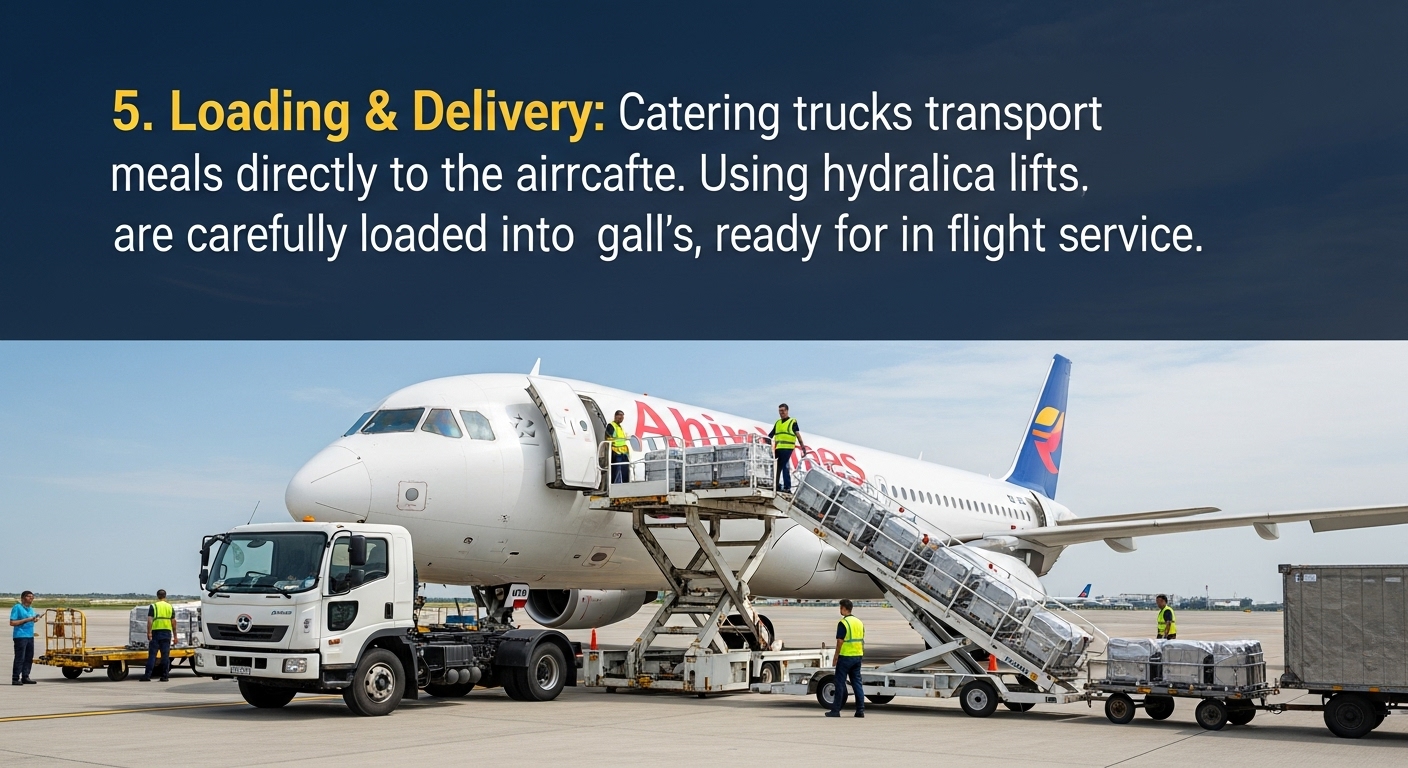
Specialized high-loader trucks are used to move catering carts directly to the aircraft doors. These vehicles are designed to align precisely with different aircraft types while maintaining temperature control during transit.
Leading inflight caterers such as LSG Sky Chefs and Gate Gourmet operate global logistics networks that coordinate seamlessly with airline ground operations.
Step 6: Aircraft Loading and Onboard Handling
Once the catering trucks arrive at the aircraft, trained staff load the meal carts into designated galley areas. Each cart is positioned according to the flight’s service plan, ensuring cabin crew can access meals efficiently during the flight.
Before departure, crew members conduct final checks to confirm quantities, special meals, and beverages are correctly loaded. Any discrepancies must be resolved immediately, as replacements are often impossible once the aircraft leaves the gate.
Hygiene, Safety, and Regulatory Compliance
Airport catering service providers operate under some of the strictest regulations in the food industry. Compliance with aviation authorities and international food safety bodies is mandatory.
Key safety measures include:
- Regular staff health screenings
- Secure access to catering facilities
- Continuous temperature monitoring
- Detailed traceability records for every meal
These controls ensure that passengers receive safe, high-quality meals regardless of destination.
Technology and Innovation in Inflight Catering
Modern inflight caterers are increasingly adopting technology to improve efficiency and sustainability. Automated portioning, digital inventory systems, and AI-driven demand forecasting help reduce waste and control costs.
Sustainability is also becoming a major focus. Airlines and airport catering service providers are introducing eco-friendly packaging, reducing single-use plastics, and optimizing supply chains to lower environmental impact.
Why Airport Catering Service Matters to Airlines and Passengers
A reliable airport catering service directly impacts passenger satisfaction and airline reputation. Consistent meal quality enhances the travel experience, especially on long-haul flights where food plays a major role in comfort.
For airlines, efficient inflight caterers help manage costs, ensure regulatory compliance, and maintain tight flight schedules. Any delay or error in catering can disrupt operations across an entire network.
Conclusion
Behind every in-flight meal is a complex, well-coordinated operation that blends culinary expertise with aviation precision. From menu design and large-scale preparation to secure transportation and aircraft loading, an airport catering service ensures that passengers are served safely and efficiently in the skies.
Professional inflight caterers work tirelessly behind the scenes to meet strict standards while adapting to evolving passenger expectations. The next time a meal tray is placed on your table mid-flight, you’ll know just how much planning and expertise went into delivering that experience.


-

 Blog1 month ago
Simpcit6: Redefining Simplicity in a Complex World
-

 Technology5 months ago
YourAssistantLive com: The Future of Smart Digital Assistance
-
 food6 months ago
Calamariere: How to Perfectly Prepare at Home
-
 Blog6 months ago
Baddi Hub: An Emerging Industrial and Business Hotspot
-

 Health4 months ago
Nerovet AI Dentistry: Enhancing Patient Experience and Treatment Outcomes Dental Care
-

 Technology1 month ago
Voomixi com: The Digital Platform Redefining Online Interaction
-

 Technology5 months ago
Anonibs: The Trending Anonymous Image Board Platform
-

 HomeImprovment4 months ago
Acamento: How Finishing Techniques Define a Building’s Style